
Lately, map-making has become a full-contact sport. Every decade, politicians dust off their digital compasses and redraw the lines that decide who represents whom, a process meant to reflect population changes. Increasingly, though, it has become about protecting incumbents. Now, a few states have decided that even waiting for the census is too long a delay when political power is at stake.
Welcome to the mid-decade gerrymandering arms race— a new, norm-busting trend where states are redrawing their maps between censuses, not because of population shifts, but because of political panic.
How Redistricting Is Supposed to Work
Every ten years, the United States conducts a national census. Those numbers aren’t just for trivia nerds and demographers — they’re the backbone of representative democracy.
Once the Census Bureau releases population data, states use it to redraw congressional and legislative districts so each one contains roughly equal numbers of people. The idea is simple: every person should have an equal voice in government.
Think of it as democracy’s oil change — scheduled maintenance to keep the system running smoothly. You don’t do it on a whim. You do it when the odometer hits the mark. It’s worth pointing out though, there is no federal law that prevents revisiting the maps between censuses, it’s just a “norm”– one of those assumed rules that for decades or centuries, everyone has agreed to go by.
How Gerrymandering Already Skews the Game
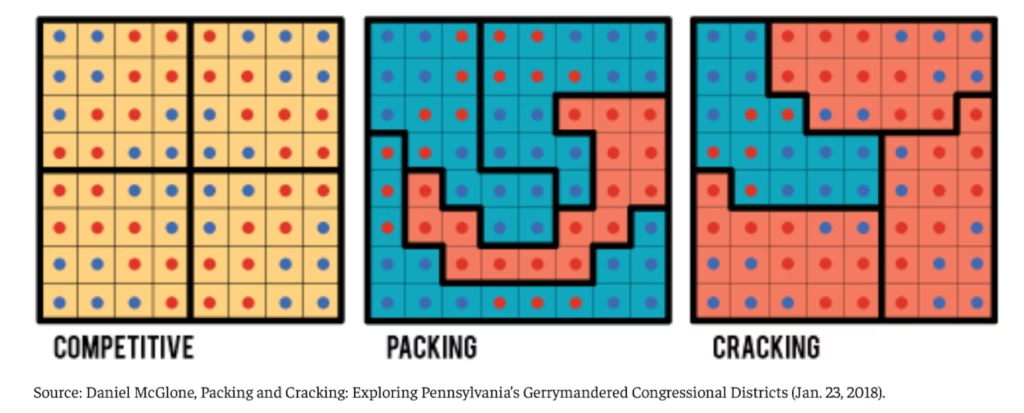
Of course, even during normal redistricting cycles, the process isn’t exactly apolitical. Whichever party controls the state legislature usually controls the mapmaking. They use software, demographic data, and voting history to sculpt districts that all but guarantee their side keeps power.
This is what’s known as partisan gerrymandering — drawing districts that favor one party over another. It’s technically legal. The Supreme Court said as much in Rucho v. Common Cause (2019), ruling that partisan gerrymandering is a “political question” beyond the reach of federal courts.
Some states tried to fix the problem by creating independent redistricting commissions — California, Michigan, and Colorado, for example — to keep politicians’ hands off the crayons. Others, like Texas and North Carolina, took the opposite lesson: if it’s legal, it’s fair game.
It’s democracy by vending machine logic: sure, it’s technically food, but maybe don’t make a diet out of it.
The New Norm Violation: Mid-Decade Redistricting
Now comes the next escalation. States like Texas have started redrawing maps again — mid-decade, years after the last census.
Normally, new maps stay in place until the next census, both for predictability and fairness. That’s not a law, exactly — it’s a norm. And norms are what make democracy function when laws fall short.
Redrawing maps midstream breaks that norm. It turns a routine administrative process into an ongoing political weapon.
The motivation isn’t subtle. Some lawmakers are watching demographic or political trends that threaten their majority and thinking, “Better redraw the lines before the next election.” It’s less like scheduled maintenance and more like changing the Monopoly rules halfway through because you’re losing.
The Domino Effect: A Gerrymandering Arms Race
Once one state crosses that line, others feel compelled to follow suit — not out of principle, but survival.
If Texas redraws its maps for partisan advantage, why wouldn’t California, or Indiana, or Virginia? Nobody wants to be the only one playing fair in a rigged game.
The result is an arms race of gerrymandering, where both parties feel justified in constantly reshaping the playing field. It’s not about representation anymore; it’s about preemptive strikes.
Imagine if every baseball team could move the outfield fence whenever they were up to bat. Eventually, everyone’s playing in a miniature stadium — and nobody’s impressed when the home runs keep coming.
Why This Is Dangerous (Even If You Like the Outcome)
It’s tempting to shrug. After all, gerrymandering mostly affects politicians, not your day-to-day life, right?
Wrong. When maps are drawn to predetermine outcomes, elections lose meaning. Representatives stop worrying about the general public and focus instead on the narrow sliver of voters who can challenge them in primaries. That means more ideological extremism, less compromise, and a Congress that functions like a bad group project — where everyone hates each other and no one does the reading.
More fundamentally, breaking the “once-a-decade” norm signals that any rule can be bent if power is on the line. That’s not partisan strategy. That’s institutional rot.
Political scientists call this norm erosion — when the unwritten rules of fair play that keep democracy stable start to crumble. Once they go, they’re hard to rebuild. You can pass new laws, but you can’t legislate trust.
Where Reform Still Lives
The good news — and yes, there’s some — is that reforms haven’t vanished completely.
A growing number of states have adopted independent or bipartisan commissions to draw maps transparently. Citizen-led ballot initiatives have succeeded in places like Michigan and Colorado. And even in states with partisan control, lawsuits under state constitutions have occasionally reined in excesses.
At the federal level, the Freedom to Vote Act included provisions to standardize redistricting practices nationwide, but it’s stalled in Congress. Still, the debate continues, and public awareness is the first step.
Maps can be redrawn. So can the boundaries of what we’re willing to tolerate.
The Bottom Line
Redistricting was supposed to be a once-in-a-decade adjustment to reflect how America changes. Instead, it’s becoming a rolling contest of who can twist the system fastest.
The danger isn’t just that one party gains an edge — it’s that voters lose faith that the game has any rules left at all.
If democracy is a trust fall, this is the part where everyone starts stepping back.