
We don’t often think about who draws the political maps that determine our congressional districts—but we should. Because the answer is… politicians. And they know exactly what they’re doing.
Welcome to the world of gerrymandering—an age-old political tool that’s evolved into a data-driven science of voter suppression, partisanship, and polarization.
What Is Gerrymandering?
The U.S. Constitution leaves redistricting (the redrawing of legislative district boundaries) up to the states. Most states assign that task to their state legislatures—meaning the very people whose political futures depend on the shape of the districts are the ones who get to draw them. Unsurprisingly, that creates a temptation for abuse.
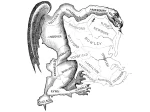
The term gerrymander dates back to 1812, when Massachusetts Governor Elbridge Gerry signed off on a district map so contorted, it resembled a salamander. A political cartoonist dubbed it a “Gerry-mander,” and the name stuck.
What Makes a District “Fair”?
Here’s where it gets tricky: fairness in redistricting isn’t black-and-white. There are multiple, sometimes conflicting, definitions of what a “fair” district looks like. Should districts reflect:
- Geographic continuity (keeping cities or counties whole)?
- Political balance (a near 50/50 split between parties)?
- Racial or cultural representation (ensuring minority communities aren’t drowned out)?
- Compactness and community of interest?
All of these are valid principles. But emphasizing one can undermine another—creating room for manipulation.
How Gerrymandering Dilutes Votes
The most common tricks are packing and cracking. Let’s say you have a state that leans 55% Republican and 45% Democrat. With some creative districting, the legislature might pack as many Democratic voters as possible into one or two districts—giving them near-guaranteed wins there—while spreading Republican voters across the rest of the map.
This results in wasted votes for Democrats in packed districts, and marginal Republican wins everywhere else. The majority party ends up with a disproportionate share of the seats, even when the vote totals are relatively close statewide.
This is how minority parties in a state can be effectively silenced—not through fraud or suppression, but by drawing lines on a map.
The Vanishing Middle
One of the most toxic outcomes of gerrymandering is the near-extinction of competitive districts. When a district is safely Republican or safely Democratic, the real contest becomes the primary election, not the general election.
And what happens when you only have to worry about your own party’s base? You cater to the extremes.
Over time, this has fueled polarization in Congress and state legislatures. Politicians aren’t rewarded for compromise anymore—they’re rewarded for purity, provocation, and obstruction. Gerrymandering helps make bipartisanship a liability.
Gerrymandering Goes High-Tech
It’s worth noting: this isn’t a problem from a bygone era. In fact, it’s getting worse.
With the rise of big data, sophisticated voter modeling, and advanced mapping software, politicians can draw districts with pinpoint precision. They know who you are, how you vote, and how likely you are to show up on Election Day—and they use that to create districts that are virtually unflippable.
The result is an arms race of redistricting abuse, with each party trying to outmaneuver the other whenever they gain control of a state legislature.
Is There a Fix?
Yes—but it’s complicated and uneven across the country. One of the most promising solutions is the use of independent or bipartisan redistricting commissions. These bodies are designed to draw legislative maps more fairly than legislatures motivated by political advantage.
As of now:
- Six states—Arizona, California, Colorado, Idaho, Michigan, and Washington—use independent commissions to draw congressional district maps.
- Twelve states use some form of commission—independent, politician, or hybrid—for state legislative district lines.
- In total, 21 states have implemented some kind of commission-based redistricting process, though only 13 give those commissions exclusive control over drawing maps.
Creating these commissions usually requires voter-approved ballot measures—and they’re not foolproof. But they are better. Research suggests commission-drawn maps tend to produce more competitive districts and better represent communities of interest.
Why It Matters
Gerrymandering isn’t just a wonky, insider issue. It’s one of the hidden levers warping American democracy. If we want to see a Congress that works—one that rewards compromise instead of confrontation—we need competitive elections. That means fairer maps.
Ultimately, politicians should not be choosing their voters. Voters should be choosing their politicians.