
“Enemy From Within” and the Threat of Domestic Militarization
On September 30, 2025, President Trump stood before U.S. generals in Quantico and warned that “America is under invasion from within … no different than a foreign enemy”, igniting a five-alarm fire for democracy. He exhorted that American cities be used as “training grounds” for troops tasked with tackling domestic unrest. He framed political dissent as a battlefield and implied that the military should not just back up civil authority—but be civil authority when needed.
Months ago, shortly after he was sworn in, the new Secretary of Defense, Pete Hegseth, swiftly dismissed the top Judge Advocate General (JAG) lawyers across all services. Those JAG officers are the internal legal advisors who vet orders for consistency with the Uniform Code of Military Justice (UCMJ) and constitutional constraints. Removing them weakens one of the primary internal guardrails against unlawful orders being given or obeyed. This combination of rhetoric and institutional purge should set off alarms: they are classic moves toward enabling military obedience over moral or legal restraint.
While this blog generally treads a balanced and educational line, make no mistake: this behavior is objectively aligned with practices of authoritarian regimes. The suggestion that American citizens might be treated as an “enemy from within” is not mere theater. It is an incitement to view dissent as warfare.
Why the Founders Would Have Recoiled
From the earliest days, the American founding generation was deeply suspicious of standing armies and the idea of using troops on domestic soil. The fear was clear: those in uniform might be turned, eventually, against their own countrymen. In the words of founding-era critics, a standing military posed a danger of “domestic oppression and international adventurism.”
Thus, the Constitution—and the early republic—embedded multiple structural precautions. Among them: civilian control of the military, separation of powers, and constrained executive authority. Even the language of the Insurrection Act and the Posse Comitatus Act emerges from that legacy of restraint.
The Posse Comitatus Act of 1878 remains the clearest legal barrier today. Under 18 U.S.C. § 1385, it prohibits the use of the Army or Air Force for civilian law enforcement—unless Congress explicitly allows it. Courts and scholars interpret violations when military forces are used to carry out tasks that properly belong to civil law enforcement, or when military involvement “pervades” civilian operations.
There are exceptions—most notably the Insurrection Act, which allows the president to deploy federal troops domestically in response to requests by states or to enforce federal law under certain conditions. But those are intended to be rare and strictly controlled circumstances. Trump’s rhetoric suggests he wishes to blur those lines until the exceptions become the norm.
The Military as a Bulwark — and What’s at Risk
If the military is politicized or turned inward, democracy loses one of its last defenses. Of course, military officers have their own political preferences, but even the most staunchly partisan tend to recoil at the idea of deploying their troops against the citizens they’re sworn to defend.
Military officers swear an oath to “support and defend the Constitution,” not a person or party. They are trained in laws of war, UCMJ proceedings, and chain-of-command discipline. They (ideally) are insulated from day-to-day politics so they can judge legality rather than partisan edicts.
But when JAG advice is neutralized, when loyalty to an individual is emphasized over loyalty to the constitution, and when troops are told to treat protesters or citizens as combatants, the door swings wide for abuse. Orders that once would have been rejected—not only on moral but legal grounds—become easier to issue and harder to refuse.
What might result? Suppression of dissent. Arbitrary arrests. Military-backed enforcement of political agendas. A creeping– or possibly sudden– slide toward martial control under a veneer of patriotism and “crime fighting”.
Some References to Monitor & Guard Against
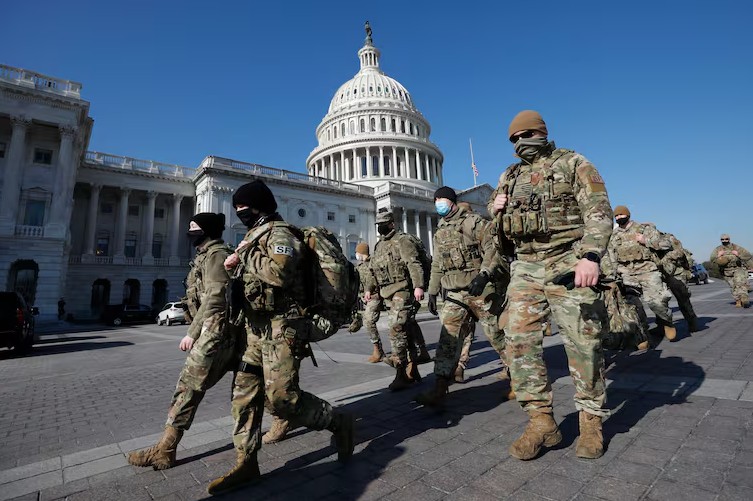
The Brennan Center for Justice does a better job at explaining the Posse Comitatus Act and its limits in real practice. For example, there are loopholes to the Act such as the deployment of National Guard units operating under federal oversight, which is likely why the Trump Administration has gone that route in Washington, DC and now Portland, Oregon. Also, the Insurrection Act is often treated as the primary legal lever to override Posse Comitatus constraints.
Frankly, just the fact that we’re hearing mention of the Posse Comitatus Act, an obscure and rarely tested law in our nation’s history, is an indicator of how “not normal” things are right now. The National Guard was originally envisioned as a state-level resource to counter-balance the federal government. The fact that they’ve become the primary tool for oppressing their citizens is yet another reason the Founders would be rolling in their graves.
Final Thoughts
This moment demands vigilance. The founding generation understood what many today forget: power concentrated without accountability corrupts. A leader who encourages the military to treat citizens as enemies is not engaging in patriotism. He is testing how far democratic norms can bend before they break.
Democracy depends on dissent, rule of law, and civilian control—not force. The military should defend the nation, not suppress it. If we lose that distinction, we lose everything else. This should be a wake-up call for even those who typically ignore politics– the commander-in-chief is literally suggesting treating American citizens as enemy combatants. You don’t have to be a bleeding-heart liberal or a libertarian zealot to realize how dangerous this moment is. If there ever were a 5-alarm fire for democracy, this would be it.